
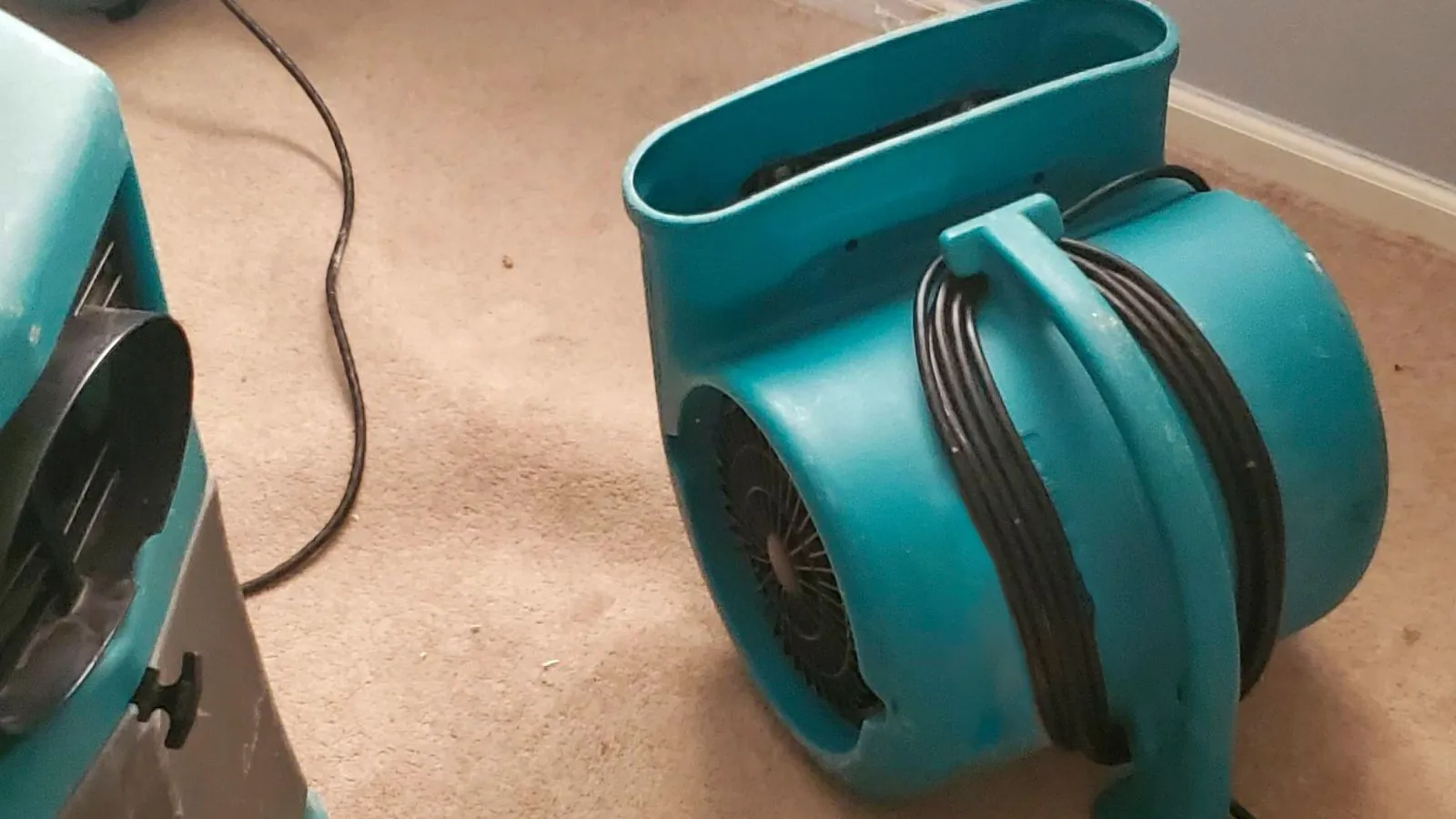
Water that has been pumped out is not gone. It is still in the drywall, framing, subfloor and air. Structural drying is how a crew removes that moisture with equipment and measurement, so the rebuild does not trap a wet wall.
Structural drying and dehumidification in Euclid, OH is the controlled removal of moisture from building materials, usually over several days, with air movers, dehumidifiers and daily meter readings. It is also called water mitigation, and the goal is dry readings, not a dry look.
Symptom-first: why does the wall still feel damp?
Homeowners often describe it as a damp wall, a floor that feels cool or a smell that will not leave even after the puddle is gone. That is stored moisture, and a mop cannot reach it. Structural drying is the process that pulls it out.
The equipment
- Air movers push dry air across wet surfaces and into cavities.
- LGR dehumidifiers pull moisture out of the air so it can keep drying materials.
- Moisture meters read water content inside wood and drywall.
- Thermal cameras show cool, wet areas behind surfaces.
- Hygrometers track temperature and humidity in the room.
Equipment is placed by measurement, not by habit. Too much air in the wrong place slows drying and uses more power.
Moisture mapping
Before equipment is set, the crew maps the structure. They record readings on a grid, mark the wet edge and photograph it. Daily mapping repeats the readings so progress is visible.
The map also tells you what has to come out. Materials that will not dry in a reasonable time are removed, and materials that read dry are left alone.
Wet materials still in the house after the water is gone? Call and ask what readings to expect.
Call (216) 541-8541How long does drying take?
Most structures take several days, and larger or deeper losses take longer. Material matters. Drywall dries faster than a thick subfloor, and hardwood floors dry slowly. Humidity outside also affects the pace.
There is no honest fixed number. The finish line is a reading, which is why daily visits matter.
Drying stages
| Day | Typical activity | Check |
|---|---|---|
| Day 1 | Extraction, equipment placement, mapping | Baseline readings recorded |
| Day 2 and 3 | Equipment adjusted, wet materials removed if needed | Readings dropping |
| Later days | Equipment trimmed as areas dry | Dry standard reached |
| Final | Equipment removed | Written readings |
Timing is an estimate and changes with the loss.
Weather and humidity make a difference
Humid summer air slows drying, while cold, dry winter air helps. A crew uses the dehumidifier to control the room, so outdoor weather matters less than it would with open windows. Keep doors and windows closed during drying, unless the crew says otherwise.
What you can do during drying
- Leave the equipment running and do not move cords.
- Keep pets and children away from machines.
- Keep the thermostat steady, since heat helps drying.
- Tell the crew about any new stains, smells or sounds.
- Save the daily reading logs for your records.
Safety while drying equipment runs
- Keep cords dry and untangled.
- Do not cover or block the machines.
- Keep children and pets away from vents and hoses.
- Call us if a machine trips a breaker.
Equipment, cost and power
Drying equipment runs continuously, so the electric draw is real. Scope and price are explained before work starts, including how many machines and days are expected. Insurers often cover drying after a covered loss, but ask yours what documentation it wants.
Related pages show where drying fits in a larger loss, such as water extraction first and wall and drywall repair after.
Questions we hear in Euclid
Water mitigation is the larger term for stopping damage, which includes extraction, removing wet materials and drying. Structural drying is the equipment-based part.
Household fans and a small dehumidifier often dry the surface and leave the cavity wet. Moisture mapping and properly sized equipment are what make the difference.
By readings. Meters are used on wood and drywall, and the numbers are compared with dry reference points from unaffected areas.
Yes, equipment draws power for days. It is usually part of the claim for a covered loss, so keep the equipment log.
Water moves out of dense materials slowly. Studs, subfloors and thick flooring release moisture over days, and stopping early leaves hidden dampness that can cause odor and mold.